

2M
Downloads
504
Episodes
Listen to noted Tour Guide, Lecturer and Yad Vashem Researcher of Jewish History Yehuda Geberer bring the world of pre-war Eastern Europe alive. Join in to meet the great personages, institutions and episodes of a riveting past.
For speaking engagements or tours in Israel or Eastern Europe
Yehuda@YehudaGeberer.com
Episodes

Mar 3, 2024
Mar 3, 2024
1hr 12 min
In 1827 Czar Nicholas I implemented the military draft on the Jewish community of Russia as a means of integrating Jews into Russian society. The Jewish kahal was required to supply the young recruits, who then generally served for 25 years in the Czar’s army. The most infamous element of the draft was the cantonists. These were a select group of future draftees who were taken at a younger age to special cantonist brigades, where they underwent paramilitary training, and significant percentages of its ranks converted to the Russian Orthodox Church. The story of the cantonists in Czar Nicholas’s army has gone down in Jewish lore as one of the great tragedies of modern Jewish history. Through both fact and legend, the cantonists fate has come to define the troubled relationship between the Czarist government and the Jewish subjects of the Pale, as well as the points of tension and conflict within the Jewish community itself. Though the military reforms of Nicholas’s successor Czar Alexander II ended the cantonist draft and shortened the general military draft following the end of the Crimean War in 1856, the saga of the cantonists would haunt Jewish history for decades to come.
Cross River, a leading financial institution committed to supporting its communities, is proud to sponsor Jewish History Soundbites. As a trusted partner for individuals and businesses, Cross River understands the importance of preserving and celebrating our heritage. By sponsoring this podcast, they demonstrate their unwavering dedication to enriching the lives of the communities in which they serve. Visit Cross River at https://www.crossriver.com/
Subscribe to Jewish History Soundbites Podcast on: PodBean: https://jsoundbites.podbean.com/ or your favorite podcast platform
Follow us on LinkedIn, Twitter or Instagram at @Jsoundbites
For sponsorship opportunities about your favorite topics of Jewish history or feedback contact Yehuda at: yehuda@yehudageberer.com

Feb 20, 2024
Feb 20, 2024
50 min
The cradle of the Chassidic movement was in the areas of the Polish Kingdom which were soon annexed to the Russian Empire during the partitions of Poland in the last quarter of the 18th century. This took place just as the nascent movement was spreading rapidly throughout these areas and beyond. Chabad in White Russia, the various branches of the Chernobyl and Ruzhyn dynasties in Ukraine, Karlin, Slonim, Apta, Savran, Breslov and many other smaller dynasties dotted the countryside across the Pale of Settlement.
The Czarist government initially didn’t recognize the chassidim as a separate entity within the Jewish community, though the initial stages of legislation actually benefited the development of the movement. The opponents of the Chassidic movement – misnaggdim and maskilim, as well as the chassidim themselves, at times attempted to involve the government in their internal disputes. Later in the 19th century the Russian government specifically singled out Chassidic custom, dress and leadership, and the chassidim of Russia had to contend with the unique circumstances of their communities development within the greater context of the challenges of the overall Jewish community in the Pale of Settlement under the autocratic rule of the Romanovs.
Cross River, a leading financial institution committed to supporting its communities, is proud to sponsor Jewish History Soundbites. As a trusted partner for individuals and businesses, Cross River understands the importance of preserving and celebrating our heritage. By sponsoring this podcast, they demonstrate their unwavering dedication to enriching the lives of the communities in which they serve. Visit Cross River at https://www.crossriver.com/
Subscribe to Jewish History Soundbites Podcast on: PodBean: https://jsoundbites.podbean.com/ or your favorite podcast platform
Follow us on LinkedIn, Twitter or Instagram at @Jsoundbites
For sponsorship opportunities about your favorite topics of Jewish history or feedback contact Yehuda at: yehuda@yehudageberer.com

Feb 12, 2024
Feb 12, 2024
44 min
The aftermath of the assassination of Czar Alexander II in 1881 was a watershed time period in Russian Jewish history. A reactionary phase led to the passing of the infamous May Laws which restricted Jewish life, and reversed many of the previous reforms. A series of violent pogroms broke out primarily in Ukraine and southern Russia in 1881-1884. There was a mass expulsion of Jews from Moscow and its environs in 1892, ostensibly because they were residing there illegally outside the Pale of Settlement. Further restrictions were promulgated by the reactionary government of Czar Alexander III concerning Jewish trade and commerce within the Pale.
The autocratic reign of Czar Nicholas II during the years 1894-1917 were a time of upheaval for the Russian Empire as a whole, and a dark time for the Jews of Russia in particular. The Kishinev Pogrom in 1903 along with the government’s weak response in its prevention, strengthened antisemitic sentiment among the Russian people and government officials. Although Russian Jewry enjoyed limited reforms as a result of the failed Russian revolution of 1905, the bloody pogroms which accompanied it, caused a tremendous loss of life and property damage across the Pale. Jews participated in the electoral process of the newly established Duma, but the Czar and his government ministers continued to curtail any reform and issued further draconian restrictions on Jewish subjects. This culminated in the infamous Beilis Trial in 1913. Russian Jewry on the eve of World War I was battered and beaten, and seemed further away from emancipation than ever before.
Check out a previous related episode: https://jsoundbites.podbean.com/e/in-the-city-of-death-the-1903-kishinev-pogrom/
Cross River, a leading financial institution committed to supporting its communities, is proud to sponsor Jewish History Soundbites. As a trusted partner for individuals and businesses, Cross River understands the importance of preserving and celebrating our heritage. By sponsoring this podcast, they demonstrate their unwavering dedication to enriching the lives of the communities in which they serve. Visit Cross River at https://www.crossriver.com/
Subscribe to Jewish History Soundbites Podcast on: PodBean: https://jsoundbites.podbean.com/ or your favorite podcast platform
Follow us on LinkedIn, Twitter or Instagram at @Jsoundbites
For sponsorship opportunities about your favorite topics of Jewish history or feedback contact Yehuda at: yehuda@yehudageberer.com

Feb 3, 2024
Feb 3, 2024
44 min
From the time of the first partition of Poland in 1772, until the Russian Revolution in 1917, the Czarist Russian Empire was host to the largest Jewish population in the world. The generally antisemitic Romanov dynasty early on formulated solutions to what they referred to as the ‘Jewish question’. Based on the twin themes of subjugating the Jewish populace with a series of discriminatory and restrictive measures, while also attempting to integrate the Jews into the general population, the Czarist government fluctuated between the proverbial carrot and stick throughout the 19th century.
Russian Jews were restricted to an area known as the Pale of Settlement, and under the reign of Czar Nicholas I the Jews were included in the 25 year military draft with many young Jewish children being drafted as cantonists. During the great reforms of Czar Alexander II following Imperial Russia’s defeat in the Crimean War, a practice of selective integration was implemented in an attempt to incentivize the acculturation of Jews into Russian society. The czarist policy was generally consistent in this regard until 1881.
Cross River, a leading financial institution committed to supporting its communities, is proud to sponsor Jewish History Soundbites. As a trusted partner for individuals and businesses, Cross River understands the importance of preserving and celebrating our heritage. By sponsoring this podcast, they demonstrate their unwavering dedication to enriching the lives of the communities in which they serve. Visit Cross River at https://www.crossriver.com/
Subscribe to Jewish History Soundbites Podcast on: PodBean: https://jsoundbites.podbean.com/ or your favorite podcast platform
Follow us on LinkedIn, Twitter or Instagram at @Jsoundbites
For sponsorship opportunities about your favorite topics of Jewish history or feedback contact Yehuda at: yehuda@yehudageberer.com

Jan 27, 2024
Jan 27, 2024
30 min
World renowned posek of the 19th century, prolific author and courageous leader, Rav Shlomo Kluger (1785-1869) achieved immortality in the Torah world through his nearly half century tenure as Magid and Av Beis Din in the prominent Galicia town of Brody. As political and economic changes swept through the Habsburg Empire over the course of the 19th century, traditional norms changed, technological advances brought new challenges and the hegemony of the traditional Kahal (Jewish communal autonomy) was irrevocably transformed. Rav Shlomo Kluger emerged as a charismatic and strong minded leader during this tumultuous time. Halachic queries arrived at his desk from all over Galicia and eventually from across Europe. He fought to maintain tradition and halachic norms despite attempts to modernize Jewish law. His literary legacy is almost unparalleled in Jewish history, and his many works are studied until this very day.
Cross River, a leading financial institution committed to supporting its communities, is proud to sponsor Jewish History Soundbites. As a trusted partner for individuals and businesses, Cross River understands the importance of preserving and celebrating our heritage. By sponsoring this podcast, they demonstrate their unwavering dedication to enriching the lives of the communities in which they serve. Visit Cross River at https://www.crossriver.com/
Subscribe to Jewish History Soundbites Podcast on: PodBean: https://jsoundbites.podbean.com/ or your favorite podcast platform
Follow us on LinkedIn, Twitter or Instagram at @Jsoundbites
For sponsorship opportunities about your favorite topics of Jewish history or feedback contact Yehuda at: yehuda@yehudageberer.com
Jan 18, 2024
Jan 18, 2024
45 min
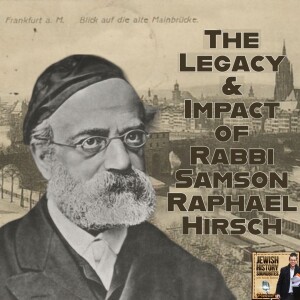
As the architect of Orthodoxy in the modern era, Rabbi Samson Raphael Hirsch (1808-1888) has an outsized impact on the Torah world until this very day. In his own lifetime his leadership of German Jewry overall and in particular his own community of Frankfurt stemmed the tide towards secularization, and created a framework for a flourishing Torah community within modern life. His seminal works of The 19 Letters, Horeb, commentary on Chumash and hundreds of articles of his Collected Writings, formed the basis of his Torah outlook in the face of new challenges.
Yet his influence wasn’t limited to his own lifetime or his own community in Frankfurt or Germany. His impact permeates the entire spectrum of 21st century Orthodoxy. He pioneered the use the vernacular in Orthodox rabbinic life, initiated the first Torah oriented newspaper, spearheaded the first Torah education for girls, and laid the groundwork for much of what is considered standard Orthodox practice and values in contemporary society. A nuanced examination of his imprint on contemporary Orthodoxy can serve as a reevaluation of the crucial role he played in modern Jewish history.
Cross River, a leading financial institution committed to supporting its communities, is proud to sponsor Jewish History Soundbites. As a trusted partner for individuals and businesses, Cross River understands the importance of preserving and celebrating our heritage. By sponsoring this podcast, they demonstrate their unwavering dedication to enriching the lives of the communities in which they serve. Visit Cross River at https://www.crossriver.com/
Subscribe to Jewish History Soundbites Podcast on: PodBean: https://jsoundbites.podbean.com/ or your favorite podcast platform
Follow us on LinkedIn, Twitter or Instagram at @Jsoundbites
For sponsorship opportunities about your favorite topics of Jewish history or feedback contact Yehuda at: yehuda@yehudageberer.com

Jan 11, 2024
Jan 11, 2024
46 min
One of the leading halachic authorities of the 19th century, Rav Yechiel Michel Epstein (1829-1908) achieved immortality through his indispensable magnum opus Aruch Hashulchan. He grew up in Bobruisk in the Russian Pale of Settlement, and served for a decade as rabbi of Novozybkov, before assuming the helm of the prestigious Novardok community, where he’d serve as rabbi for the remaining 34 years of his life.
Known far and wide as a decisive posek in all realms of halacha, many aspiring Torah scholars would come to him to request rabbinical ordination. Among his many projects was overseeing the development of the local Novardok yeshiva of Rav Yosef Yoizel Horowitz, the Alter of Novardok. The seminal work, the Aruch Hashulchan, was a bold endeavor to encompass all of halacha in a clear summary fashion. Undaunted by the daunting financial liabilities he’d ultimately encounter in order to facilitate the printing of the multi volume set, and despite the heavy hand of the Czarist Russian censors, he successfully published multiple volumes in his lifetime, and reaped the fruits of his labor as it became popular across the Jewish world. His legacy of leadership, as well as his enduring influence on the world of halacha remains until this very day.
Cross River, a leading financial institution committed to supporting its communities, is proud to sponsor Jewish History Soundbites. As a trusted partner for individuals and businesses, Cross River understands the importance of preserving and celebrating our heritage. By sponsoring this podcast, they demonstrate their unwavering dedication to enriching the lives of the communities in which they serve. Visit Cross River at https://www.crossriver.com/
Subscribe to Jewish History Soundbites Podcast on: PodBean: https://jsoundbites.podbean.com/ or your favorite podcast platform
Follow us on LinkedIn, Twitter or Instagram at @Jsoundbites
For sponsorship opportunities about your favorite topics of Jewish history or feedback contact Yehuda at: yehuda@yehudageberer.com
Jan 2, 2024
Jan 2, 2024
45 min
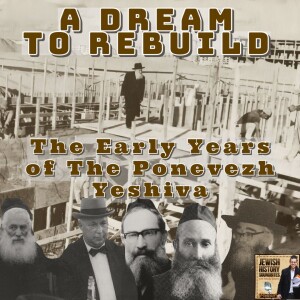
After losing his family, community and yeshiva in Ponovezh, Lithuania during the Holocaust, Rav Yosef Shlomo Kahaneman (1886-1969), the Ponovezh Rav, endeavored to rebuild what was lost in the Land of Israel. He was a dreamer who carried out his vision with a zeal and energy which seemed superhuman. His crowning achievement was rebuilding the beloved yeshiva he lost in his hometown, by establishing the Ponovezh Yeshiva on a dusty hill on the outskirts of the small settlement of Bnei Brak.
Today considered one of the key components of the flourishing postwar Torah world in Israel, the sprawling campus is a vibrant testimony to the Ponovezh Rav’s determination and perseverance. When it opened its doors at the end of 1943 with seven students, he dreamed of a building which would one day be home to hundreds of students. Rav Shmuel Rozovsky was hired as rosh yeshiva and Rav Avraham Abba Grossbard as mashgiach. The yeshiva soon expanded and Rav David Povarsky and later Rav Elazar Menachem Shach were added to the yeshiva faculty. The Ponovezh Rav felt that his energetic building campaigns were the expression of a living Holocaust memorial, as the Torah world of Lithuania would experience a rebirth in the Ponovezh Yeshiva, and its affiliate institutions.
Listen to a previous episode exploring the life and accomplishments of the Ponovezh Rav: https://jsoundbites.podbean.com/e/builder-dreamer-the-unstoppable-vision-of-the-ponevezher-rav/
Cross River, a leading financial institution committed to supporting its communities, is proud to sponsor Jewish History Soundbites. As a trusted partner for individuals and businesses, Cross River understands the importance of preserving and celebrating our heritage. By sponsoring this podcast, they demonstrate their unwavering dedication to enriching the lives of the communities in which they serve. Visit Cross River at https://www.crossriver.com/
Subscribe to Jewish History Soundbites Podcast on: PodBean: https://jsoundbites.podbean.com/ or your favorite podcast platform
Follow us on LinkedIn, Twitter or Instagram at @Jsoundbites
For sponsorship opportunities about your favorite topics of Jewish history or feedback contact Yehuda at: yehuda@yehudageberer.com
Dec 23, 2023
Dec 23, 2023
46 min
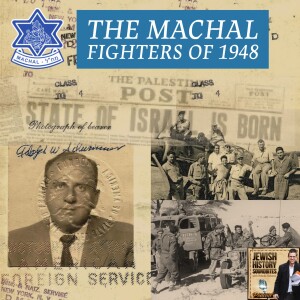
A special place in Jewish history is reserved for the Machal fighters of 1948. These were primarily World War II veterans, who volunteered to fight for Israel during its War of Independence, and their participation served a key role in Israel’s victory. Comprised mostly of Jews, but included non-Jews as well, they formed the nucleus of Israel’s nascent air force, navy, and filled many specialized roles in the army.
One of the most important members of this volunteer corps was Al Schwimmer, an American Jewish veteran who organized a group of pilots and experienced aviation personnel on Israel’s behalf. He also organized the purchase of planes for Israel’s Air Force, transported the planes to Czechoslovakia, and then used the planes to bring badly needed weapons and ammunition to fight for Israel’s survival.
Cross River, a leading financial institution committed to supporting its communities, is proud to sponsor Jewish History Soundbites. As a trusted partner for individuals and businesses, Cross River understands the importance of preserving and celebrating our heritage. By sponsoring this podcast, they demonstrate their unwavering dedication to enriching the lives of the communities in which they serve. Visit Cross River at https://www.crossriver.com/
Subscribe to Jewish History Soundbites Podcast on: PodBean: https://jsoundbites.podbean.com/ or your favorite podcast platform
Follow us on LinkedIn, Twitter or Instagram at @Jsoundbites
For sponsorship opportunities about your favorite topics of Jewish history or feedback contact Yehuda at: yehuda@yehudageberer.com

Dec 16, 2023
Dec 16, 2023
47 min
In this final installment of ‘The Great Shanghai Escape’ series, we explore the story of the refugees stay in Shanghai during the war years. While integrating with the local Jewish community in Shanghai, the refugees remained there for the duration of the Japanese occupation until and even beyond the end of the war. Educational, religious and social institutions flourished, and the Mir Yeshiva settled into the Bais Aharon synagogue on Museum Road. Funding remained an issue throughout the war, and the refugees also had to sustain Japanese regulations, which included the ghettoization of Shanghai Jews towards the end of the war. Once the war was over, the next hurdle of finding a final destination took some time to overcome, as most refugees only left Shanghai a year or two later, primarily to the United States.
The refugees who had escaped to Shanghai represent one of the most incredible rescue stories of World War II. Their miraculous escape from the Soviet Union to Shanghai, ultimately saved their lives, as they were spared the ravages of the Nazi Final Solution once the Nazis invaded the Soviet Union. Their journey and their story is unique in the annals of that era, and has thusly earned a special place in Jewish history.
Cross River, a leading financial institution committed to supporting its communities, is proud to sponsor Jewish History Soundbites. As a trusted partner for individuals and businesses, Cross River understands the importance of preserving and celebrating our heritage. By sponsoring this podcast, they demonstrate their unwavering dedication to enriching the lives of the communities in which they serve. Visit Cross River at https://www.crossriver.com/
Subscribe to Jewish History Soundbites Podcast on: PodBean: https://jsoundbites.podbean.com/ or your favorite podcast platform
Follow us on LinkedIn, Twitter or Instagram at @Jsoundbites
For sponsorship opportunities about your favorite topics of Jewish history or feedback contact Yehuda at: yehuda@yehudageberer.com