

1.9M
Downloads
481
Episodes
Listen to noted Tour Guide, Lecturer and Yad Vashem Researcher of Jewish History Yehuda Geberer bring the world of pre-war Eastern Europe alive. Join in to meet the great personages, institutions and episodes of a riveting past.
For speaking engagements or tours in Israel or Eastern Europe
Yehuda@YehudaGeberer.com
Episodes
Saturday Feb 22, 2020
Saturday Feb 22, 2020
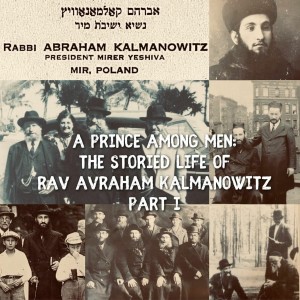
With seemingly endless energy, few have matched the communal activism of Rav Avraham Kalmanowitz (1891-1964). From his days in Slabodka, to a young Rabbi in Rakov and then Tiktin, his activities were never limited in scope. He became the fundraiser and president of the Mir Yeshiva in Poland and managed to find time to assist refugees from the Soviet Union, participate in the activities of Agudas Yisroel, and also assist Rav Chaim Ozer Grodzinski on the Vaad Hayeshivas.
Follow us on Twitter or Instagram at @Jsoundbites
You can email Yehuda at yehuda@yehudageberer.com
Wednesday Feb 19, 2020
Wednesday Feb 19, 2020
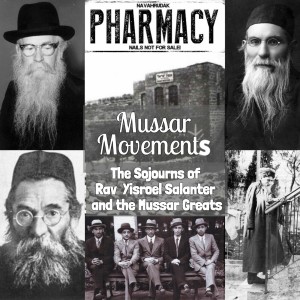
In honor of the yahrtzeit of the Mussar Movement's founder Rabbi Yisrael Salanter (1809-1883), an interesting characteristic stands out about him and many of his followers- they were travelers. Both he and some of his greatest students, spent a large portion of their lives traversing the length and breadth of Europe and even beyond, some making it to Israel. Some moved by choice, and others as a result of circumstance. But the journeys produced an excitement and a story.
Where did they go? Why were they constantly on the move? What does it tell us about the Mussar Movement? As we follow them on their journey, we'll observe their exploits, challenges and achievements.
Follow us on Twitter or Instagram at @Jsoundbites
You can email Yehuda at yehuda@yehudageberer.com
Monday Feb 17, 2020
Monday Feb 17, 2020
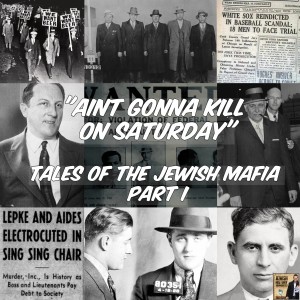
As first generation Americans growing up in immigrant neighborhoods, some Jews turned towards organized crime and joined the Mob. While maintaining close ties to their families, communities and even Jewish tradition, they led lives that included bootlegging during Prohibition, gambling rackets, theft and even murder.
Their lives were a paradox - criminals who were proud Jews. This collection of stories is about heroes and villains. It will bring us to the World Series, alcohol smuggling, the streets of Brooklyn and Sing Sing Prison. We'll meet Arnold Rothstein - the architect of modern organized crime, Mayer Lansky - the brains and one of the big bosses of the Mafia, Abe Reles - one of the contract killers of Murder Inc. and many more.
Part 3- https://jsoundbites.podbean.com/e/gangster-on-the-roof-tales-of-the-jewish-mafia-part-iii/
Follow us on Twitter or Instagram at @Jsoundbites
You can email Yehuda at yehuda@yehudageberer.com

Saturday Feb 15, 2020
Saturday Feb 15, 2020
Few figures can match the excitement, intensity and mystique as expressed in the enigmatic personality of the Kotzker. So much has been written about Rav Menachem Mendel Morgenstern of Kotzk (1788-1859), and yet much remains shrouded in mystery until this very day.
A demanding leader and uncompromising in his pursuit for truth, he got disappointed when his Chassidim weren't reaching the high ideals he set for them. His legendary sharp retorts contained the depth of his teachings. At times radical and at times misunderstood, the fire which he lit in Kotzk shines forth and provides warmth till this very day.
Check out the sequel to this episode: https://jsoundbites.podbean.com/e/those-who-know-dont-speak-the-story-of-the-kotzk-izhbitz-dispute/
Follow us on Twitter or Instagram at @Jsoundbites
You can email Yehuda at yehuda@yehudageberer.com

Wednesday Feb 12, 2020
Wednesday Feb 12, 2020
Rav Binyamin Beinush Finkel (1913-1990) was one of the most colorful Roshei Yeshiva in recent times. A great talmid chacham who did everything to hide his greatness, he remains something of a mystery to even those who were close with him. At the same time, he was a lively and funny personality, and in many ways the ultimate people's person.
Hiding himself and his deeds to an extreme, he also displayed a warmth and understanding for the common and simple folk whom he encountered. With so many facets to his personality, these anecdotes can perhaps paint a partial picture of this legendary and beloved Rosh Yeshiva, presented here in honor of his 30th yahrtzeit.
Follow us on Twitter or Instagram at @Jsoundbites
You can email Yehuda at yehuda@yehudageberer.com
Wednesday Feb 12, 2020
Wednesday Feb 12, 2020
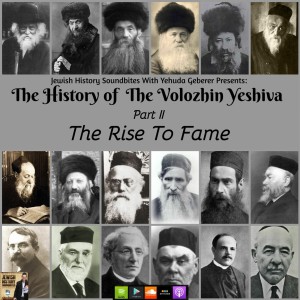
Under the watch of it's founder, the Volozhin rose to to prominence. Rav Chaim Volozhiner created a sophisticated system of fundraisers, who also spread the word about the Yeshiva and added to its prestige. He introduced innovations in both learning and organizational structure.
Following his passing in 1821, his son R' Itzele (1780-1849) took over and it flourished under his watch. R' Itzele was also quite active in communal affairs, and in the 1840's was involved in a fascinating saga concerning Russian Jewry. When Dr. Max Lilienthal attempted a reform of Jewish education, he actually came down to Volozhin to meet with R' Itzele. Volozhin and it's heads now stood at the forefront of Jewish leadership in the Russian Empire.
Follow us on Twitter or Instagram at @Jsoundbites
You can email Yehuda at yehuda@yehudageberer.com
Saturday Feb 08, 2020
Saturday Feb 08, 2020
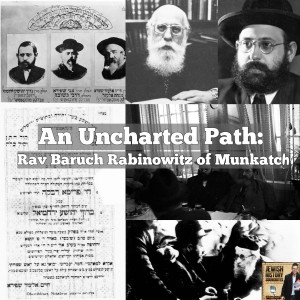
In the rebuilding of Chassidic courts in the post war era, the story of Munkatch is one of the more tragic ones. More of a human story than one of a dynasty, it revolves around the upheavals in the life of Rabbi Baruch Rabinowitz (1914-1997). As a successor to his famed father in law the Minchas Elozor of Munkatch, following the Holocaust he abdicated the throne. He also turned towards Zionism, which was a marked departure from the legacy of Munkatch.
The story of his rescue activities during the war, coupled with his post war Rabbinic career is another facet of his life, which was otherwise dominated by the future of the Munkatch dynasty.
Check out the episode on the Minchas Elazar: https://jsoundbites.podbean.com/e/uncompromising-zealot-the-life-and-times-of-the-minchas-elazar/
Follow us on Twitter or Instagram at @Jsoundbites
You can email Yehuda at yehuda@yehudageberer.com
Thursday Feb 06, 2020
Thursday Feb 06, 2020
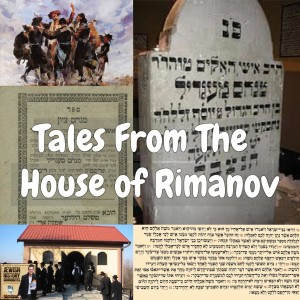
One of the father's of Chassidus, Rav Mendele of Rimanov had a central influence on the development of the movement in Poland, Galicia & Hungary. He displayed strong leadership, an emphasis on prayer and an endless love for his people.
Succeeded by his assistant known to posterity as Rav Hirsh Meshares, who was one of the more unique personalities in the history of the movement. In the spirit Chassidus, we'll delve into some tales that bring the legend of Rimanov to life.
Follow us on Twitter or Instagram at @Jsoundbites
You can email Yehuda at yehuda@yehudageberer.com
Monday Feb 03, 2020
Monday Feb 03, 2020
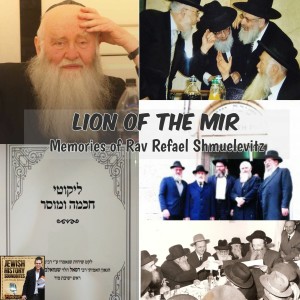
As one of the last members of the "old school" style Rosh Yeshiva, Rav Refoel Shmuelevitz (1937-2016) was indeed a unique breed. Warm, personal and caring, he was also sharp and demanding in learning. Down to earth and cognizant of the world around him, he nevertheless occasionally expressed unconventional views. Unafraid to speak his mind and not subscribing to a specific pervasive ideology, he represented the old time aristocracy of Lithuanian Yeshiva world which had nurtured him.
In honor of his yahrtzeit, we present some personal reminisces of this great man.
Follow us on Twitter or Instagram at @Jsoundbites
You can email Yehuda at yehuda@yehudageberer.com
Saturday Feb 01, 2020
Saturday Feb 01, 2020
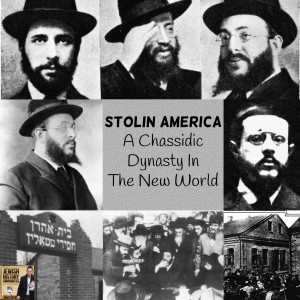
One of the oldest dynasties in the history of the Chassidic movement, was also one of the pioneers to strike roots on American shores. Karlin-Stolin - which also had one of the oldest Chassidic communities in the Land of Israel - was a unique group back in Europe as well.
One of the sons of Rav Yisroel Perlow (1869-1921), (the "Yenuka" of Stolin), Rav Yaakov Chaim (c. 1897-1946) answered the call of the Karlin Chassidim in the United States and immigrated in 1924. A fatherly figure, he died childless while visiting his followers in Detroit. He was soon followed by his only surviving brother Rav Yochanan (1900-1955), who arrived in 1947. Between the two of them, the foundations of the rebuilding of Karlin-Stolin were laid in the new world.
Follow us on Twitter or Instagram at @Jsoundbites
You can email Yehuda at yehuda@yehudageberer.com