

1.9M
Downloads
480
Episodes
Listen to noted Tour Guide, Lecturer and Yad Vashem Researcher of Jewish History Yehuda Geberer bring the world of pre-war Eastern Europe alive. Join in to meet the great personages, institutions and episodes of a riveting past.
For speaking engagements or tours in Israel or Eastern Europe
Yehuda@YehudaGeberer.com
Episodes

Sunday Jul 17, 2022
Sunday Jul 17, 2022
Within the framework of Operation Reinhard, the Nazi extermination of Polish Jewry, the SS built three death camps in Eastern Poland - Belzec, Treblinka & Sobibor. The latter was the smallest of the three, and a quarter of a million primarily Polish and Dutch Jews were killed in its gas chambers during its year and a half of existence. It was at Sobibor that on October 14, 1943 a great prisoner escape took place. Led by the son of a Polish rabbi named Leon Feldhendler & a Soviet Jewish Red Army officer named Sasha Pechersky, these two unlikely leaders joined together to formulate a plan to save not just themselves but to give all of the 600 inmates at Sobibor an equal chance to escape.
The revolt killed several SS officers, 300 Jewish prisoners made it to the forest and nearly 50 survived the war. As they broke for the fences, Pechersky demanded that anyone who survive should tell the world what went on in Sobibor.
To dedicate an episode in the Jewish History Soundbites ‘Jewish Saviors of the Holocaust’ series, please contact Yehuda at yehuda@yehudageberer.com
Jewish History Soundbites is coming to NY! Register here for the upcoming tour of the Mt. Judah cemetery with Yehuda Geberer on July 29, 9:30 am
For sponsorship opportunities about your favorite topics of Jewish history contact Yehuda at: yehuda@yehudageberer.com
Subscribe To Our Podcast on:
PodBean: https://jsoundbites.podbean.com/
Follow us on Twitter or Instagram at @Jsoundbites
You can email Yehuda at yehuda@yehudageberer.com
Thursday Jul 14, 2022
Thursday Jul 14, 2022
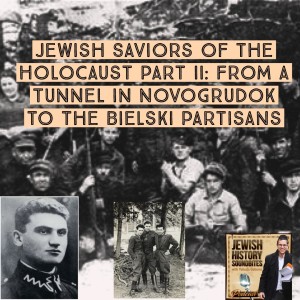
On the night of September 26, 1943 232 Jews escaped through a tunnel from the Novogrudok Ghetto. Nearly 170 survived, primarily by joining the Bielski partisans who operated nearby in the Naliboki forest. This was likely the greatest escape in Nazi occupied Europe throughout the entire war and Holocaust.
The tenacity and courage of the last Jews of the Novogrudok ghetto to dig a 250 meter tunnel leading to the forest, combined with the capability of joining Tuvia Bielski and his partisans, facilitated one of the most astounding stories of Jewish survival during the Holocaust. Tuvia Bielski famously said that he prioritizes saving lives over killing Germans. The result was that his partisan unit was a family camp which saved over 1,200 Jews, among them the escapees of the Novogrudok tunnel.
To dedicate an episode in the Jewish History Soundbites ‘Jewish Saviors of the Holocaust’ series, please contact Yehuda at yehuda@yehudageberer.com
Jewish History Soundbites is coming to NY! Register here for the upcoming tour of the Mt. Judah cemetery with Yehuda Geberer on July 29, 9:30 am
For sponsorship opportunities about your favorite topics of Jewish history contact Yehuda at: yehuda@yehudageberer.com
Subscribe To Our Podcast on:
PodBean: https://jsoundbites.podbean.com/
Follow us on Twitter or Instagram at @Jsoundbites
You can email Yehuda at yehuda@yehudageberer.com

Thursday Jul 07, 2022
Thursday Jul 07, 2022
Rav Simcha Bunim Alter (1898-1992), the Lev Simcha of Ger, was a leader during a time period of growth and consolidation. Having grown up in Poland and emerged as a great Torah scholar, he moved to Palestine in 1934, and then returned to Poland shortly before the war and was a crucial player in facilitating his father’s escape from the Nazi inferno. Upon his older brother the Bais Yisrael’s assuming the mantle of leadership in 1948, the Lev Simcha sojourned in Paris and Antwerp for several years before returning to Israel. In 1977, at the age of 79, he became the leader of the Ger Chassidic community, and immediately embarked on a series of innovative measures to enhance the lives of his chassidim whom he cared for in a fatherly way. He pioneered the establishment of Chassidic communities on the periphery for cheaper housing, and encouraged his followers to look after their health and quit smoking. In many ways he expressed his practical understanding and ability to creatively confront the changing demographics his era had been presented with. On the world scene, he continued the legacy of his forebears as the leader of Agudas Yisrael in the political realm, and presented the idea of the Daf Yomi of Yerushalmy at the Knessiah Gedolah in 1980.
For sponsorship opportunities about your favorite topics of Jewish history contact Yehuda at: yehuda@yehudageberer.com
Subscribe To Our Podcast on:
PodBean: https://jsoundbites.podbean.com/
Follow us on Twitter or Instagram at @Jsoundbites
You can email Yehuda at yehuda@yehudageberer.com

Tuesday Jul 05, 2022
Tuesday Jul 05, 2022
Jewish History Soundbites is proud to launch a special series entitled ‘Jewish Saviors of the Holocaust’. It will explore the narratives of Jews under Nazi occupation risking their lives to save others during the Holocaust. Each unique profile will explore another story, angle and individual (or group of individuals) who though their own lives were at risk still did everything in their power to save others.
The series opens with the story of Yona Tiefenbrunner, known to the orphans he saves as ‘Monsieur’. Born in Germany, he arrived as a refugee in Belgium shortly before the war’s outbreak. He initially opened an orphanage at his own expense in order to assist German Jewish refugee children. With the Nazi occupation of Belgium and the subsequent deportations in 1942, his Brussels orphanage emerged as an island of rescue, as the Nazis miraculously allowed the orphanage to operate and spare the children from deportation to the east. Maintaining a semblance of normalcy under increasingly challenging conditions, Yona managed to care for the orphans' physical and religious welfare until liberation. Following the war, the orphanage relocated to Antwerp and cared for children survivors until its closing in 1960.
To dedicate an episode in the Jewish History Soundbites ‘Jewish Saviors of the Holocaust’ series, please contact Yehuda at yehuda@yehudageberer.com
For sponsorship opportunities about your favorite topics of Jewish history contact Yehuda at: yehuda@yehudageberer.com
Subscribe To Our Podcast on:
PodBean: https://jsoundbites.podbean.com/
Follow us on Twitter or Instagram at @Jsoundbites
You can email Yehuda at yehuda@yehudageberer.com

Monday Jun 27, 2022
Monday Jun 27, 2022
Prague has had its fair share of characters throughout its storied history, yet Shlomo Yehuda Rapoport (1790-1867) or Shir as he was known was definitely one of the more interesting ones. Born into a rabbinic family in Lvov, Shir married the daughter of Rav Aryeh Leib Heller, the author of the Ketzos Hachoshen. Though he remained a scholarly, observant and rabbinic Jew for the remainder of his life, he also associated with the emerging Galician Haskalah (Jewish Enlightenment) of his era.
His intellectual pursuits included the study of medieval Jewish philosophy, languages, general science, history and literature, while his social circles included the famous maskilim of Galicia. In an attempt to alleviate his financial struggles his friend Yosef Perl arranged for his appointment to the rabbinate of Tarnopol. Traditionalist opposition made the position unsustainable, and in 1840 he was appointed rabbi of Prague where he remained until his passing.
For sponsorship opportunities about your favorite topics of Jewish history contact Yehuda at: yehuda@yehudageberer.com
Subscribe To Our Podcast on:
PodBean: https://jsoundbites.podbean.com/
Follow us on Twitter or Instagram at @Jsoundbites
You can email Yehuda at yehuda@yehudageberer.com
Sunday Jun 19, 2022
Sunday Jun 19, 2022
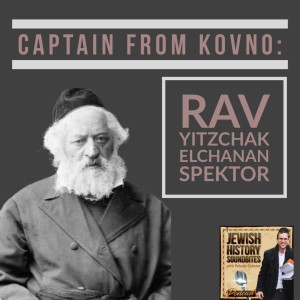
Perhaps the most acclaimed leader of Russian Jewry of the 19th century was Rav Yitzchak Elchanan Spektor (1817-1896). A long-time Rabbi of Kovno, his impact reached the far reaches of the Russian Empire and beyond. He served as the leading posek in all halachic matters, the arbiter of many disputes and lent his name to diverse causes such as the Kovno Persushim Kollel and Chovevei Zion. Exhibiting leadership on the burning issues of the day, he forged a relationship with the financial elite in St. Petersburg and with Czarist government officials lobbying on behalf of the general community.
For sponsorship opportunities about your favorite topics of Jewish history contact Yehuda at: yehuda@yehudageberer.com
Subscribe To Our Podcast on:
PodBean: https://jsoundbites.podbean.com/
Follow us on Twitter or Instagram at @Jsoundbites
You can email Yehuda at yehuda@yehudageberer.com
Sunday Jun 12, 2022
Sunday Jun 12, 2022
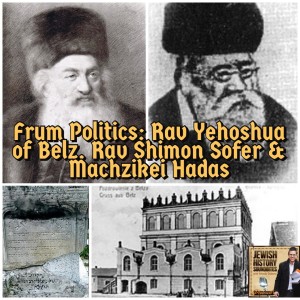
Founded in 1879 the Rav Yehoshua of Belz and Rav Shimon Sofer, the Machzikei Hadas political party was the first Orthodox political party in Jewish history. The unique status of Galician Jewry of the 19th century, as a heavily traditional, demographically large community who had already received emancipation from the Habsburg monarchy in 1867, led the leaders of Orthodox Jewry there to utilize the benefits of emancipation to further the cause of traditional Jewry. Rav Shimon Sofer even got elected to the Austrian parliament.
The mouthpiece of the organization was a newspaper of the same name, and emerged as another modern tool to preserve tradition. Though its influence waned after an initial decade of success, this pioneering endeavor left a lasting impact on the developing environment of Orthodox politics.
For sponsorship opportunities about your favorite topics of Jewish history contact Yehuda at: yehuda@yehudageberer.com
Subscribe To Our Podcast on:
PodBean: https://jsoundbites.podbean.com/
Follow us on Twitter or Instagram at @Jsoundbites
You can email Yehuda at yehuda@yehudageberer.com

Friday Jun 03, 2022
Friday Jun 03, 2022
The recent passing of Uri Zohar is an opportunity to pay tribute to this unique individual who made the journey from the apex of the Israeli entertainment world to embracing religious observance.
With Shavuos approaching, it’s an opportunity to reflect on some of the historical events which are associated with this season throughout history. From the deportations of Hungarian Jewry in 1944, to liberation a year later, to the events of the First Crusade and the Khmelnytsky massacres of 1648-49, many tragic events somehow occurred around this time. The yahrzeits of both the the Baal Shem Tov and the Ger Rebbe the Imrei Emes are on Shavuos as well. These and several other curious events, are analyzed in these musings on Shavuos and Jewish History.
For sponsorship opportunities about your favorite topics of Jewish history contact Yehuda at: yehuda@yehudageberer.com
Subscribe To Our Podcast on:
PodBean: https://jsoundbites.podbean.com/
Follow us on Twitter or Instagram at @Jsoundbites
You can email Yehuda at yehuda@yehudageberer.com

Sunday May 22, 2022
Sunday May 22, 2022
Rav Klonymous Kalman Halevi Epstein (1751-1823) is known by his posthumously published work the Maor Veshemesh. Born into a poor family, he spent the bulk of his childhood selling bagels in the streets of Krakow to support his family. He eventually emerged as a budding Torah scholar, and later joined the nascent Chassidic movement, becoming a close follower of the Noam Elimelech of Lizhensk.
He later attempted to establish a chassidic presence in Krakow, but faced much opposition from the establishment. Eventually returning to his home town of Neustadt, he gained a following, while he himself continued to travel to the great tzadikim of his day. His burial site in Krakow is much visited until this very day, while his primary legacy in the form of his sefer Maor Veshemesh is sometimes referred to as ‘the Shulchan Aruch of Chassidus’.
For sponsorship opportunities about your favorite topics of Jewish history contact Yehuda at: yehuda@yehudageberer.com
Subscribe To Our Podcast on:
PodBean: https://jsoundbites.podbean.com/
Follow us on Twitter or Instagram at @Jsoundbites
You can email Yehuda at yehuda@yehudageberer.com
Monday May 16, 2022
Monday May 16, 2022
Jews have lived in Venice for more than a millennium. In 1516 the Jewish community of Venice was restricted to one area of the city, and this came to be known as the Ghetto, the first of its kind in Europe. Jewish life flourished, and it became a pioneering center of the printing of Hebrew books, most famously in the printing press of the Christian Daniel Bomberg.
Though there were many famous Jewish personalities of Venice, including Don Yitzchak Abarbanel who lived out his last years in the city, the most famous Venetian Jew never even existed at all. Shylock is a fictional character and the primary antagonist in Shakespeare’s play The Merchant of Venice. While Shakespeare used - and to a certain extent created - anti-Semitic tropes which unfortunately were perpetuated by subsequent anti-Semites over the ensuing centuries, in many ways the character reflects the restricted reality of Venice’s Jews at the time.
For sponsorship opportunities about your favorite topics of Jewish history contact Yehuda at: yehuda@yehudageberer.com
Subscribe To Our Podcast on:
PodBean: https://jsoundbites.podbean.com/
Follow us on Twitter or Instagram at @Jsoundbites
You can email Yehuda at yehuda@yehudageberer.com