

1.9M
Downloads
480
Episodes
Listen to noted Tour Guide, Lecturer and Yad Vashem Researcher of Jewish History Yehuda Geberer bring the world of pre-war Eastern Europe alive. Join in to meet the great personages, institutions and episodes of a riveting past.
For speaking engagements or tours in Israel or Eastern Europe
Yehuda@YehudaGeberer.com
Episodes
Tuesday Mar 01, 2022
Tuesday Mar 01, 2022
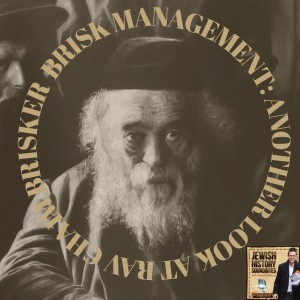
Rav Chaim Soloveitchik, known as Rav Chaim Brisker (1853-1918), has enjoyed an outsized influence on the methodology of Talmudic study and the development of the modern Torah world. As a historical figure he was not only influential but beloved as well, with countless stories of his kindness, care and leadership initiative as rabbi in Brisk as well as in wider rabbinic circles across the Pale of Settlement.
From his adopting abandoned children on his doorstep to his attempts at implementing pension plans for deceased rabbis widows and orphans, his care and attention to detail bespoke the responsibility he felt towards the less fortunate of society. His Torah teaching career commenced at age 27 in the Volozhin yeshiva, and he later had informal interactions with students while in Brisk. From these oral teachings, together with a limited textual legacy in the form of his published works, his imprint on the development of the Torah world is felt until this very day.
See previous episode about Rav Chaim Brisker: https://jsoundbites.podbean.com/e/voice-of-clarity-a-tribute-to-rav-chaim-brisker/
For sponsorship opportunities about your favorite topics of Jewish history contact Yehuda at: yehuda@yehudageberer.com
Subscribe To Our Podcast on:
PodBean: https://jsoundbites.podbean.com/
Follow us on Twitter or Instagram at @Jsoundbites
You can email Yehuda at yehuda@yehudageberer.com
Wednesday Feb 23, 2022
Wednesday Feb 23, 2022
Rav Shalom Noach Berezovsky was appointed Slonim Rebbe shortly prior to his father in law’s passing in 1981. As he had served as the rosh yeshiva of Slonim for decades, this enabled him to enjoy a close relationship with his followers who were for the most part his own students.
The background of the Slonim dynasty has its roots in White Russia, with antecedents in the court of Rav Mordechai of Lechovitz and Rav Moshe of Kobrin. Rav Avraham Weinberg, the Yesod Ha’avodah, founded the Slonim dynasty. He was succeeded by his grandson Rav Shmuel Weinberg, who passed away in exile in Warsaw. Following World War I, his son Rav Avraham Weinberg, the Bais Avraham, reestablished the Slonim court in Baranovich.
For sponsorship opportunities about your favorite topics of Jewish history contact Yehuda at: yehuda@yehudageberer.com
Subscribe To Our Podcast on:
PodBean: https://jsoundbites.podbean.com/
Follow us on Twitter or Instagram at @Jsoundbites
You can email Yehuda at yehuda@yehudageberer.com
Thursday Feb 17, 2022
Thursday Feb 17, 2022
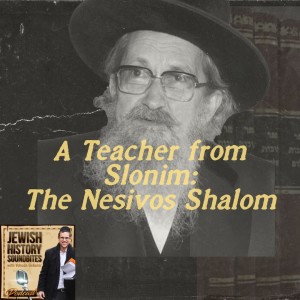
The Slonim Rebbe, Rav Shalom Noach Berezovsky (1911-2000) was known by his popular work the Nesivos Shalom. Having grown up in Baranovich in the center of the Slonim chassidic dynasty, he was appointed by the rebbe the Bais Avraham to record his weekly discourses. Following his marriage and move to Tverya in 1935, he first found employment as a rosh yeshiva in Achei Temimim-Lubavitch in Tel Aviv.
Having heard of the decimation of the Slonim community in Europe during the Holocaust, he embarked on ambitious mission: to found a Slonim yeshiva in Yerushalayim with the goal of rebuilding the chassidus. With his father in law election as the Slonim Rebbe, he was now the rosh yeshiva of a fledgling chassidic community. He then succeeded his father in law the Birkas Avraham as rebbe in 1981.
For sponsorship opportunities about your favorite topics of Jewish history contact Yehuda at: yehuda@yehudageberer.com
Subscribe To Our Podcast on:
PodBean: https://jsoundbites.podbean.com/
Follow us on Twitter or Instagram at @Jsoundbites
You can email Yehuda at yehuda@yehudageberer.com
Saturday Feb 12, 2022
Saturday Feb 12, 2022
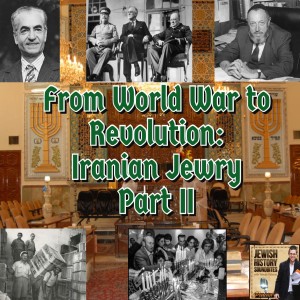
Iranian Jewry in the 20th century saw much upheaval. The rise of the Pahlavi dynasty brought much hope to the Persian Jewish community. Iran served as a center of some important events of World War II with the Anglo-Soviet invasion of the country, as host of the Teheran Conference, the exit of the Polish Anders Army through Iran and many Jewish refugees arriving there including the famous ‘Yaldei Teheran’.
Another period of relative stability was interrupted towards the end of the 1970’s with the Revolution and the subsequent Iran-Iraq war. Much emigration occurred around this time. Rabbi Herman Neuberger and other activists engaged in the rescue of many Iranian Jews, and this sparked a renaissance of Iranian Jewish life in the United States. Many immigrated to Israel as well. Rabbi Neuberger arranged their attendance of Ner Israel - tuition free - and many emerged as leaders of the Iranian Jewish community.
For sponsorship opportunities about your favorite topics of Jewish history contact Yehuda at: yehuda@yehudageberer.com
Subscribe To Our Podcast on:
PodBean: https://jsoundbites.podbean.com/
Follow us on Twitter or Instagram at @Jsoundbites
You can email Yehuda at yehuda@yehudageberer.com
Sunday Feb 06, 2022
Sunday Feb 06, 2022
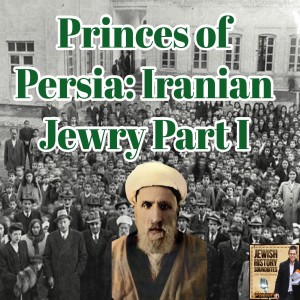
The ancient Jewish community of Persia/Iran is one of the oldest Jewish communities in the world. The site of the Purim story and many Biblical and Talmudic era luminaries, it continued to flourish through times of stability and persecution.
One of the great rabbinical leaders in the city of Hamedan, Iran in modern times was Chacham Mola David Sasson Rabban (1879-1974). As rabbi of the community he oversaw its growth and later decline in mid 20th century to widespread emigration, while corresponding with rabbis across Iran and in neighboring Iraq. He also ran the local Otzar Hatorah school, which was part of network of traditional Jewish education which facilitated the renaissance of Jewish life in Iran and later in Iranian diaspora Jewish communities.
This podcast is sponsored in honor of the release of the first sefer of its kind! The writings of the Av Bet Din of the city of Hamadan, Iran, Rabbi David Sasson Rabban, including a whole section on the minhagim of the Jews of Iran. Published by Machon Magen Avot publishing house, and is available on their website moroccanhalacha.com, along with all other sefarim by Machon Magen Avot. In Israel it can be obtained in the Sifria Hasefaradit Rechov Bucharim 4. https://magen-avot.myshopify.com/products/the-writings-of-chacham-rabbi-david-sasson-rabban-of-hamedan-iran
For sponsorship opportunities about your favorite topics of Jewish history contact Yehuda at: yehuda@yehudageberer.com
Subscribe To Our Podcast on:
PodBean: https://jsoundbites.podbean.com/
Follow us on Twitter or Instagram at @Jsoundbites
You can email Yehuda at yehuda@yehudageberer.com

Sunday Jan 30, 2022
Sunday Jan 30, 2022
With the passing of the fifth rebbe of Chabad the Rashab in 1920, his son Rav Yosef Yitzchak Schneerson (1880-1950), the Rayatz, or the Freidiker (previous) Rebbe, took over the Chabad-Lubavitch movement at a time of crisis. Through the decades of his leadership he expressed a commitment to the ideals of his father in regards to Zionism, while dealing with the practical upheavals of Jewish life including the Holocaust and the founding of the State of Israel.
This was continued by his son in law and successor Rav Menachem Mendel Schneerson. While in theory, the opposition to ideas such as ‘aschalta digeula’ remained, practical considerations of caring for the needs of the Jewish People and furthering Jewish observance took precedence.
Of special note was the relationship enjoyed between both Rebbe’s and the third president of the State of Israel, Zalman Shazar.
For sponsorship opportunities about your favorite topics of Jewish history contact Yehuda at: yehuda@yehudageberer.com
Subscribe To Our Podcast on:
PodBean: https://jsoundbites.podbean.com/
Follow us on Twitter or Instagram at @Jsoundbites
You can email Yehuda at yehuda@yehudageberer.com
Saturday Jan 22, 2022
Saturday Jan 22, 2022
Rav Yehuda Aszod (1796-1866) was one of the architects of the emerging Hungarian Orthodoxy of the 19th century. A student of the Maharam Banet, he went to serve in the rabbinate and as a rosh yeshiva in several towns, the most prominent of which was in Dunaszerdahely in the Austrian Empire.
Ideologically positioned between neo Orthodoxy as represented by Rav Ezriel Hildesheimer and Hungarian Ultra-Orthodoxy as represented by Rav Hillel Lichtenstein, Rav Yehuda Aszod emerged as a leader of mainstream orthodoxy along with his colleague the Ksav Sofer. For decades he confronted modernist trends, any assault on tradition, and engaged in polemics with assimilationists and reformists alike. In 1864 he headed a delegation which met with Emperor Franz Jozef I in an unsuccessful attempt to block the opening of a reformist rabbinical seminary.
For sponsorship opportunities about your favorite topics of Jewish history contact Yehuda at: yehuda@yehudageberer.com
Subscribe To Our Podcast on:
PodBean: https://jsoundbites.podbean.com/
Follow us on Twitter or Instagram at @Jsoundbites
You can email Yehuda at yehuda@yehudageberer.com

Saturday Jan 15, 2022
Saturday Jan 15, 2022
Rabbi Aryeh Kaplan (1934-1983) was a dazzling light on the Jewish history scene of the 20th century. With family origins in Thessaloniki, Greece, he was born in the Bronx, and eventually studied at Yeshiva Torah Vodaath and Mir Yeshiva in Jerusalem. Returning to the US he became a physicist and then a pulpit rabbi, before entering the world of Jewish outreach.
In his later years he maintained a prodigious literary output, authoring a large amount of works across the gamut of Jewish thought, mysticism, chassidic thought and practical Jewish observance. Much of this was commissioned by NCSY, which is where he did much of his kiruv activities. His tragic passing at the young age of 48 cut short his life work and accomplishments, but his impact continues until today through his many published works.
This episode has been sponsored by NCSY in honor of the republication of Rabbi Aryeh Kaplan’s books. Connect more to Mitzvos and Yiddishkeit with Rabbi Aryeh Kaplan Zt”l’s republished and enhanced books. The library of 10 books covers the deeper meaning of some of the most important mitzvos. A project of NCSY in conjunction with Artscroll.
For More Information and to Buy the Books:
For sponsorship opportunities about your favorite topics of Jewish history contact Yehuda at: yehuda@yehudageberer.com
Subscribe To Our Podcast on:
PodBean: https://jsoundbites.podbean.com/
Follow us on Twitter or Instagram at @Jsoundbites
You can email Yehuda at yehuda@yehudageberer.com

Sunday Jan 09, 2022
Sunday Jan 09, 2022
Following the partitions of Poland in the last quarter of the 18th century, the largest Jewish community in the world found themselves under the rule of the Romanov dynasty in the Russian Empire. Each Czar formulated a distinct policy in regards to the Jewish population, and many of these policies, along with the Jewish community’s reaction, often has ramifications until this very day.
Catherine the Great was czarina during the years of the partition itself, and she commenced her Jewish policy influenced by the ideas of enlightened absolutism. Jews were granted partial emancipation but the beginnings of their confinement to what would become known as the Pale of Settlement began as well. At the turn of the 18th-19th centuries, Alexander I assumed power, and he initially was viewed as a somewhat enlightened ruler, primarily due to the opportunities afforded through his ‘Jew constitution’ promulgated in 1804.
He was succeeded by Czar Nicholas I, who went down in history as a sworn enemy of the Jews and an evil ruler. It was under his watch that the infamous cantonist decrees took place. He also attempted to meddle with internal Jewish affairs by reforming the educational institutions and by the annulment of the kahal communal structure.
For sponsorship opportunities about your favorite topics of Jewish history contact Yehuda at: yehuda@yehudageberer.com
Subscribe To Our Podcast on:
PodBean: https://jsoundbites.podbean.com/
Follow us on Twitter or Instagram at @Jsoundbites
You can email Yehuda at yehuda@yehudageberer.com

Sunday Jan 02, 2022
Sunday Jan 02, 2022
Prewar student of Rav Yerucham Levovitz and the Brisker Rov, leader during the Mir Yeshiva’s wartime escape to Shanghai, and postwar builder of Bais Hatalmud in Brooklyn, Rav Leib Malin (1906-1962) was the ‘Lion of the Mir’.
In part 1 of examining his life and accomplishments, we examine his family background, leadership role in the escape to Shanghai, and his replanting Torah through his Bais Hatalmud yeshiva in the postwar United States. The unique circumstances of this rebuilding attempt, made his all encompassing vision of what a yeshiva is a historic landmark in the role that the yeshiva institution was to play in revitalizing traditional society. No longer to be limited to an educational role, a yeshiva was to be a lifelong communal affiliation, a revolutionary role which has arguably bore fruit through the contemporary yeshiva community worldwide.
This episode has been sponsored by 20 Minute Daf. A daf yomi shiur led by Reb Shaul Greenwald, 20 minute daf is where you feel the geshmak of Daf Yomi. In just a little over 20 minutes, you'll get a clear and thorough explanation of the sugya. Listen to 20 Minute Daf on all podcast platforms, WhatsApp, and at 20minutedaf.com
For sponsorship opportunities about your favorite topics of Jewish history contact Yehuda at: yehuda@yehudageberer.com
Subscribe To Our Podcast on:
PodBean: https://jsoundbites.podbean.com/
Follow us on Twitter or Instagram at @Jsoundbites
You can email Yehuda at yehuda@yehudageberer.com